Visual Agents Survey GitHub

A survey on visual agents

Visual Agents in the Era of Self-Evolution

Toward Recursive Self-Improvement

An engraved indigo planet, with a space probe tracing orbital paths toward a distant star
Visual models
Perception · Planning · Output
Agent harness
Orchestration · Memory · Skills
Tools · Monitoring & recovery
  • Dong Chen1
  • Shuai Ge1
  • Yu Fu1
  • Xiangyu Ren1
  • Zhihao Zhang1
  • Hao Wang2
  • Changshuo Wang3
  • Jiayi Ji4
  • Henghui Ding5
  • Shuting He1

1 SUFE2 MBZUAI3 UCL4 Xiamen University5 Fudan University

The survey

How do visual agents improve from experience?

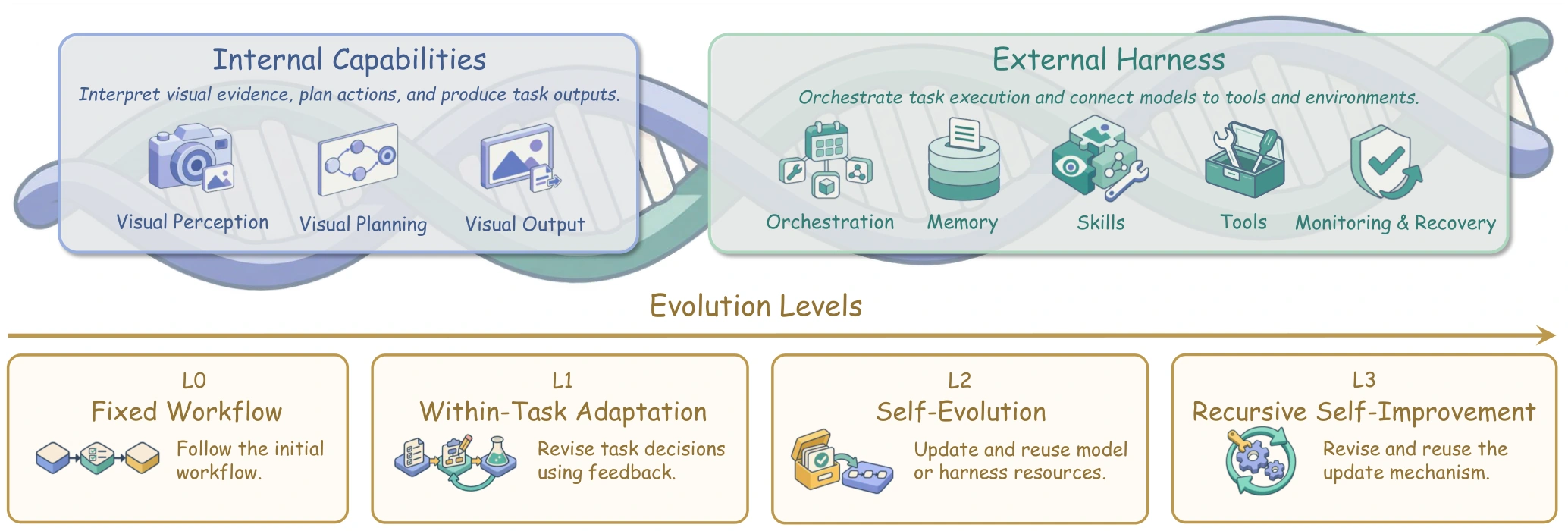
A visual agent uses visual observations to guide task operations. One or more models provide visual perception, planning, and output capabilities. The harness coordinates execution through orchestration, memory, skills, tools, and monitoring and recovery.

The paper's diagram of visual agent foundations and the four levels of adaptation and evolution
Figure 2. Visual agent foundations and levels of adaptation and evolution View in the paper ↗
  • Visual understanding
  • Visual generation & editing
  • Computer use
  • Embodied interaction

Taxonomy

What changes, and when?

L0 provides the fixed-workflow reference. The paper distinguishes L1–L3 by what experience changes, whether that change persists, and how it is used later.

L0Fixed workflow

The agent selects a workflow from the goal and initial observations. As it runs, new observations supply inputs to the scheduled operations and the working state records progress. The selected workflow stays fixed for the task.

What changes
Operation inputs and working state
When
During task execution
Used in
The scheduled operations of the current task
Browse L0 references

How it works

The harness runs the selected sequence of perception, reasoning, and tool operations. Inputs and intermediate results can vary across runs while the workflow remains the same.

ViperGPT [12]. The system generates a program for a visual question and executes it using vision modules. The selected program serves as the fixed workflow for that question.

L1Within-task adaptation

Observations and execution feedback can change how the agent handles a task already in progress. It may gather missing visual evidence, repair a plan, choose a different tool, or refine a proposed output before the task ends.

What changes
The active workflow, proposed output, or action
When
Within the current task
Used in
Subsequent decisions in that task
Browse L1 references

Mechanisms in the survey

  • Adaptive Perception changes which region, viewpoint, or earlier observation the agent inspects.
  • Feedback-Driven Planning revises subgoals or recomputes the remaining plan.
  • Dynamic Harness Orchestration changes which model, tool, skill, or agent is called as conditions change.
  • Output and Action Refinement revises proposed outputs or actions using feedback about their quality or feasibility.
  • Execution Monitoring and Control tracks task state, verifies progress, and intervenes when execution deviates from its goal.

Inner Monologue [53]. The language planner uses updated object detections and success feedback to revise manipulation subgoals as previously occluded objects become visible.

L2Self-evolution

A fixed updater uses experience to revise model or harness resources. The agent retains the updated resources for use in later tasks, trials, or training rounds.

What changes
Model parameters or reusable harness resources
When
Between tasks, trials, or training rounds
Used in
Later execution or learning
Browse L2 references

Mechanisms in the survey

  • Model-Level Evolution changes model parameters using experience from earlier interactions or attempts.
  • Memory-Driven Capability Evolution acquires, consolidates, and retrieves retained experience for later use.
  • Skill and Tool-Level Evolution builds, revises, or reuses skills and tools across tasks.
  • Orchestration-Level Evolution retains revised workflows, routing strategies, or harness configurations.
  • Dynamic Data and Task Evolution changes which experiences or tasks are collected, generated, or selected for later learning.

ViLoMem [107]. It learns and consolidates separate visual and logical error guidelines, then retrieves relevant guidance by image matching and question-conditioned reranking.

L3Toward recursive self-improvement

Experience revises a component of the updater itself. The revised updater must use that component to produce or guide a later retained update. If the procedure that revises the updater also evolves, it must be reused to revise the updater again.

What changes
A component of the updater
When
Across improvement rounds
Used in
Producing a subsequent retained update
Browse L3 references

Mechanisms in the survey

  • Evolving Learning Signals and Experience uses a revised curriculum or experience generator to supply later training attempts.
  • Evolving Memory and Context Management revises how experience is retained or retrieved for later updates.
  • Evolving Update Mechanisms reuses a revised procedure for designing or applying subsequent interventions.
  • Evolving Evaluation and Validation reuses a revised evaluator or verifier to guide later training or decisions about which updates to adopt.

GUI0 [151]. Rollout success rates reward a curriculum agent for selecting tasks near the actor’s capability boundary. The revised curriculum agent generates tasks for the next round of actor training.

Evaluation

Benchmarks and Evaluation of Visual-Agent Evolution

Compare what different protocols measure, from immediate task performance to the effects of retained resources and revised improvement mechanisms.

Task-level performance

Assess task success and how the agent achieves it, including grounded reasoning, planning and execution, output quality, recovery, and safety.

Table IV ↗

Self-evolution

Measure capability acquisition after an update, retention on earlier tasks, and generalization or transfer under new conditions.

Table V ↗

Recursive self-improvement

Trace a revised updater to a later retained update. When the revision procedure also evolves, trace its reuse, then use controlled comparisons to estimate the effect of the revisions.

Table VI ↗
Browse the benchmarks and protocols

Research outlook

Open Challenges and Future Directions

Balancing Capability Retention and Generalization

Preserve useful visual knowledge and execution strategies across successive updates while adapting to new observations, objects, configurations, and goals. Recording when each skill applies could help agents retrieve, adapt, and recombine skills within interaction and memory budgets.

Preventing Objective Hacking in Visual Agent Evolution

Apparent gains can come from exploiting evaluation objectives, environments, or tool interfaces, even under sandboxing. The paper calls for independent evaluation and task-specific authorization across update cycles and workflow reuse. It also discusses externally enforced safeguards, independent audits, and human oversight.

Maintaining Consistency in Long-Horizon Execution

With incomplete observations or unexpected action effects, an agent must infer progress while staying aligned with the original goal. Tracking the evidence behind task milestones could help it reassess state and revise the remaining plan when earlier assumptions no longer hold.

Verifying Genuine Recursive Self-Improvement

Reusing a revised updater shows that it participates in a later update. The open question is whether it improves the update process over successive rounds. The paper proposes comparisons under matched experience and compute budgets, alongside tracing how a revision affects later data, feedback, and learning.

Benchmark Development for Visual Agents

Task outcomes and intermediate checks cannot by themselves establish how individual harness components contribute. The paper proposes combining task assessments, component-specific tests, and controlled interventions to compare capability development, reliability, and resource costs across successive updates.

The literature

Reference Library

Search the survey bibliography and filter by publication year, venue, or the section where a work is cited.

Loading references…

    Citation

    Cite this survey

    Manuscript citation.

    @unpublished{chen_visual_agents,
        title  = {Visual Agents in the Era of Self-Evolution:
                  Toward Recursive Self-Improvement},
        author = {Chen, Dong and Ge, Shuai and Fu, Yu and Ren, Xiangyu
                  and Zhang, Zhihao and Wang, Hao and Wang, Changshuo
                  and Ji, Jiayi and Ding, Henghui and He, Shuting},
        note   = {Manuscript}
      }